

Mirror, Mirror: a Visual Treat
By Sadia Ashraf
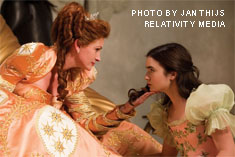 Mirror, Mirror
(2012) may not stimulate the gray matter but will certainly delight that the eyes. Directed by Tarseem Singh, the movie employees his customary visual extravagance that is a gastronomic eye-feast, resembling his other films
Cell
(2000),
The Immortals
(2011)
and
The Fall
(2006) –where story is often sacrificed for the spectacle. Singh’s trademark imagination overcomes the story in this surreal retelling of
Snow White and the Seven Dwarves
.
Mirror, Mirror
(2012) may not stimulate the gray matter but will certainly delight that the eyes. Directed by Tarseem Singh, the movie employees his customary visual extravagance that is a gastronomic eye-feast, resembling his other films
Cell
(2000),
The Immortals
(2011)
and
The Fall
(2006) –where story is often sacrificed for the spectacle. Singh’s trademark imagination overcomes the story in this surreal retelling of
Snow White and the Seven Dwarves
.
Singh is a true renaissance man who shows his Indian heritage in the Mirror, Mirror while infusing it with his western upbringing and merging it with his love of classical art and painting. The anachronistic film jumps through time, language, architecture and attire as easily as a circus lion jumps through hoops of fire. With refreshing disregard to an actual period setting, the film’s architecture mixes the Baroque period with transitional décor in the queen’s castle which has gigantic balconies overlooking bucolic and blue painted-by-Rubens-skies; Hollywood glamour style mirrored and crystal furniture; Rococo gilded opulence in its pillars, thrones and ceiling; and Arabian style gold turrets.
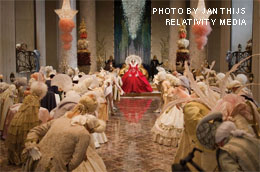 The film relies on Flemish paintings for its imagery. The aristocratic class seems derived from paintings of Van Dyck and Vermeer and the working class dioramas seem to be the handiwork of Brueghel. The costumes— designed by the late Eiko Ishioka (who has worked on most of Singh’s films) — are timeless masterpieces that are equally Vermeer as they are Dior and John Paul Gaultier. The gravity-defying, brightly hued, taffeta and silk creations might even earn Ishioka a posthumous Oscar nomination. While its costumes have been universally admired, Critics have bashed
Mirror, Mirror’s
slim storyline and awkward screenplay making its box office debut, no fairytale.
The film relies on Flemish paintings for its imagery. The aristocratic class seems derived from paintings of Van Dyck and Vermeer and the working class dioramas seem to be the handiwork of Brueghel. The costumes— designed by the late Eiko Ishioka (who has worked on most of Singh’s films) — are timeless masterpieces that are equally Vermeer as they are Dior and John Paul Gaultier. The gravity-defying, brightly hued, taffeta and silk creations might even earn Ishioka a posthumous Oscar nomination. While its costumes have been universally admired, Critics have bashed
Mirror, Mirror’s
slim storyline and awkward screenplay making its box office debut, no fairytale.
The fairytale genre has become Hollywood’s cherished new trend with successful TV shows such as Once Upon A Time , Grimm and another more apocalyptic, upcoming movie this summer, Snow White and the Huntsman . Mirror, Mirror takes liberties with the original Grimm’s fairytale, with a revisionist and female-empowered plot that transforms Snow White from being a helpless heroine who need rescuing, to a Jane Eyre-ish character who becomes emancipated, leaves the limited confines of the castle and learns the way of the world; ultimately rescuing the male protagonist—physical and spiritually. Lily Collins—slightly reminiscent of Audrey Hepburn and bearing no resemblance to her father Phil Collins— plays the congenial Snow White.
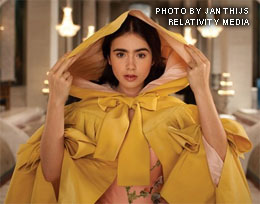 Snow White comes of age, when she encounters poverty and grim reality in the village. The political and economic parallels between reality and fable are evident in her discovery of back-breaking taxes levied at the common man and how the queen rules them with tactics of fear and suppression—not unlike America’s war on terror. Snow White discovers that the exorbitant queen has been secretly crafting fear—with a monster she unleashes at will— to oppress the masses and then justifying the taxes as expenditure necessary for their security.
Julie Roberts displays a virtuoso ease with which she plays the affable, yet odious stepmother. Though carrying off the superlative costumes in dazzling backgrounds with queenly aplomb— she never quite convinces us that she is evil to the core, with her lighthearted bantering, incessantly humorous gaze, and a love-sick preoccupation with securing the attention of the handsome prince instead of a single-minded motivation to kill Snow White.
At one point, longingly looking into the magic mirror, Roberts utters, “These are not wrinkles they are merely crinkles,” as the film also aspires to critique a beauty industry that equates pain with attractiveness, and urges women to pump themselves with silicon and Botox. Roberts struggles in a painful contraption that squeezes her into a whalebone corset and undergoes agonizing procedures that include a face mask with bird feces and getting her lips plumped with bee stings while maggots, scorpions and snakes inject her with venomous cures.
As with most Hollywood actors playing European roles, Roberts vacillates between an artificial British accent and a befuddled American falsetto, though, she delivers a few comical lines superbly—like her rebuttal to Prince Alcott’s extolling of Snow White’s beauty: ”Blah blah blah, her hair is not black, it’s raven and she’s 18 years old and her skin has never seen the sun, so of course it’s good.” The prince says “I think Snow White is the most beautiful woman in the whole world” and the queen quips, “Agree to disagree.”
Armie Hammer—whose breakthrough role was playing the buff Winklevoss twins in
The Social Network
(2010) — plays the handsome prince Alcott in
Mirror, Mirror
is tossed to and fro between Snow white and the queen, depending on who has the amorous upper hand. In the film’s subverting of the male-female protagonists’ traditional roles, the prince is defeated by Snow White in verbal and actual sword play, while comically becoming a human love-slave puppy to the queen. The prince is also emasculated by the seven dwarves in several skirmishes.
Humorous supplements to the story, the dwarves accost the landed gentry as highway bandits and are not hardworking miners as in the Disney version of
Snow White.
They are the ideal comical foils to the lackluster prince and will be cherished by children as this a rare family film that can be enjoyed by all ages. The film is supported by actors Nathan Lane who plays a butler/not-quite-evil henchman to the queen and Mare Winningham who is superb as a submissive and subversive servant.
While Mirror, Mirror may not be intellectually stimulating but it is a fun caper that is a visual treat for the whole family.
